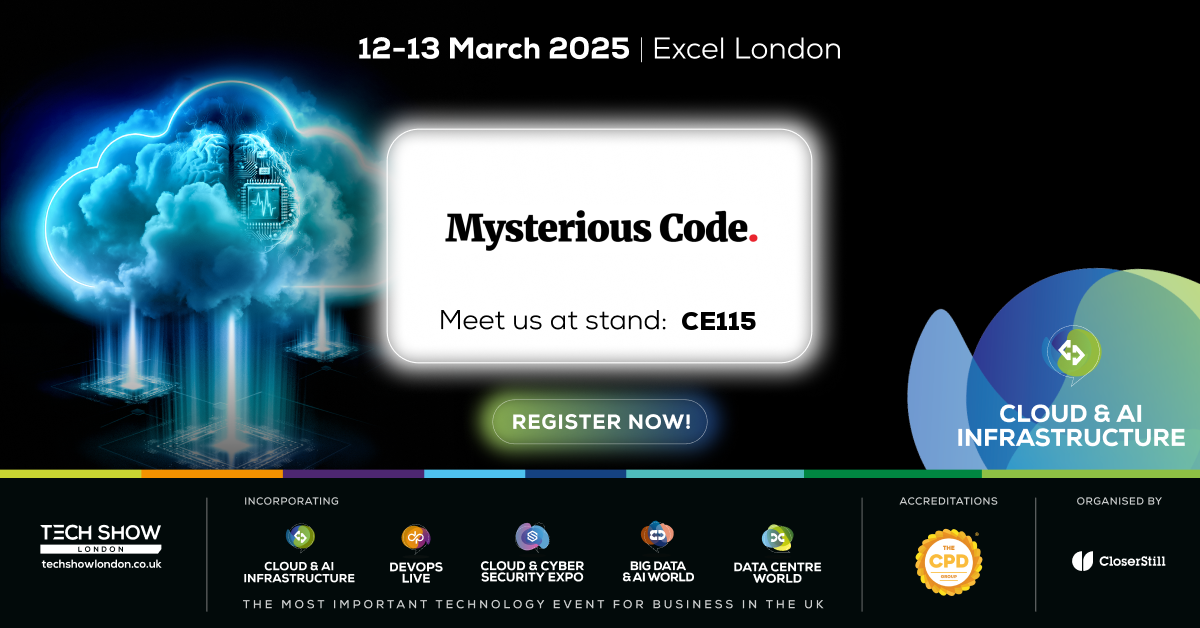
Mysterious Code at Cloud & AI Infrastructure - meet us at Tech Show London 2025
We’re excited to announce that Mysterious Code will be part of the Cloud & AI Infrastructure event at Tech Show London 2025!
Posts on AWS.
We’re excited to announce that Mysterious Code will be part of the Cloud & AI Infrastructure event at Tech Show London 2025!
As a member of the AWS Public Sector Partner Program, Mysterious Code Ltd will leverage its expertise to empower government, education and nonprofit entities with secure, scalable, and compliant cloud solutions built on AWS infrastructure. By combining AWS’s industry-leading cloud platform with Mysterious Code’s specialized knowledge and experience, public sector customers can expect enhanced capabilities in areas such as data security, compliance, and cost optimization.
If you’re using CloudFormation, you probably know about cfn-lint - a
linting tool created by the CloudFormation team to validate templates against the schema and best practices. Validating
each template before deployment is in itself actually
considered a best practice by AWS.
However, simply using validate-template in the Console or CLI
only validates the basic syntax of the template,
not the actual contents and resource specification. That’s where using a linter like cfn-lint
can be helpful to make sure you’re not making any obvious mistakes or going against best practices in your resources.
You can use cfn-lint in a number of ways during development, including simply within command-line, using git pre-commit
hooks or as a plugin to your IDE. All those options, while helpful in day-to-day work, do not establish code quality
standards for your overall codebase. To do that, it’s ideal to include linting as part of CI/CD pipeline and/or
pull/merge-requests approval process.
That is where you can come across a hurdle: cfn-lint does not have an official, up-to-date docker image
AWS GuardDuty analyses various events happening on your AWS account and can notify you when suspicious activity takes place. Right now, GuardDuty is specific to a region and needs to be enabled in each region you want to monitor (though AWS recommends you enable it in all regions to ensure global actions are monitored). Going through GuardDuty console in every AWS region can be a daunting task, and quite time consuming if you have multiple AWS accounts which you’d like to connect into Master-Member setup. Luckily, CloudFormation supports enabling and setting up GuardDuty detectors, so you can use it to make it a little bit less painful.
If you’re keeping in touch with new services provided by AWS, you probably heard about new security monitoring tool: GuardDuty. You probably also noticed a whole new family of Elastic Load Balancers (v2), which includes Network Load Balancers (NLB). Deploying those two new services may generate some unexpected results - and here’s why.
Start with a free second opinion: 30 minutes with our founder. No account access needed, and you keep a short written note of what we covered.